The maritime sector is facing a new EU law at the end of 2026: the Circular Economy Act (CEA). As part of the Act’s development, the CirclesOfLife consortium provided a contribution. During the EU public consultation, we offered recommendations to align the upcoming Act with the programme our maritime sector is currently developing. Our purpose is to contribute to transparent and consistent agreements and requirements for circularity and sustainability, as a solid foundation for a competitive and future-proof maritime manufacturing industry.
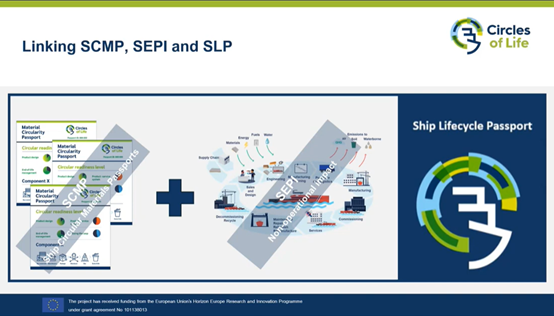
CirclesOfLife clarifies that our project contributes to anchoring circularity in the EU maritime sector. Partially based on the Digital Product Passport (DPP) guidelines outlined in the Ecodesign for Sustainable Products Regulation (ESPR) and adapted for the maritime sector, CirclesOfLife is developing a blueprint for a Ship Lifecycle Passport (SLP) and a Ship Circular Materials Passport (SCMP). Additionally, the Shipyard Environmental Performance Index (SEPI) will evaluate the environmental footprint of shipyard processes which is relevant information for the passports. This unique standardised software tool will help assess and improve shipyard sustainability and circularity across newbuilds, repairs, and end-of-life operations.
Identifying the gaps
CirclesOfLife identifies gaps in (upcoming) legislation that hinder the implementation of circular practices and limit shipyards’ ability to meet the EU’s circular economy targets and maintain their competitiveness.
Recommendations
Our consortium therefore urges the European Commission to consider the following key recommendations for the Circular Economy Act (CEA).
- Reinforce the single market for waste and secondary raw materials – there is a need for harmonisation and standardisation of definitions, methodologies, and certification schemes, as well as recognition of Green Marine Europe’s certification as a specific and holistic, pioneering certification on circularity in shipping industry.
- Increase both supply and demand of high-quality, verifiable secondary raw materials at competitive prices – there is, among other things, a need for a distinct product group for ships under ESPR and regulatory requirements for retrofit, maintenance, repair, and dismantling.
- ‘Get the economics right’ for circular markets to ensure competitiveness and scale – one of the recommendations is to establish tax and financial incentives to offset higher initial costs for circular certifications, retrofits, and the use of verified secondary materials.
Download submission
You can download and read our feedback to the public consultation for CEA here and inform yourself about the recommendations in detail. It’s also available on our website CirclesOfLife.eu.
Business case
The measures aim to establish a strong business case for ship lifecycle management in Europe, starting from newbuild and including fully automated, efficient, safe, healthy, and environmentally sound ships dismantling and waste treatment downstream management. This will position Europe as a frontrunner in this market and ultimately enhance the competitiveness of European shipyards, maritime equipment manufacturers, and shipowners. That business case should be profitable for both the shipbuilding supply chain and shipowners.
More about EU Circular Economy Act
The European Commission plans to propose a Circular Economy Act (CEA) to enhance the EU’s economic security and competitiveness, while promoting more sustainable production, circular economy business models, and decarbonisation. The Act will facilitate the free movement of secondary raw materials and waste within Europe. It will also increase the supply of high-quality recycled materials and stimulate demand for these materials in the EU.
The Circular Economy Act is crucial for the maritime manufacturing industry, particularly in shipbuilding, maintenance, repair, conversion, and dismantling. This must be considered in the context of European shipyards facing stiff competition from Asian counterparts benefiting from supportive public policies, leading to a decline in market share and capacity in Europe.
As a Horizon European-funded project, CirclesOfLife shares the Commission’s vision of fostering market demand for secondary raw materials and creating a unified, competitive single market for waste and secondary resources.
SEA Europe Foundation
Some more background is to be found in our earlier published article about the EU Clean Deal | Circular Economy Act, with the recommendations of our European Shipyards’ and Maritime Equipment Association, SEA Europe.
EMIS
CirclesOfLife also contributed to the European Maritime Industrial Strategy, available on our website.