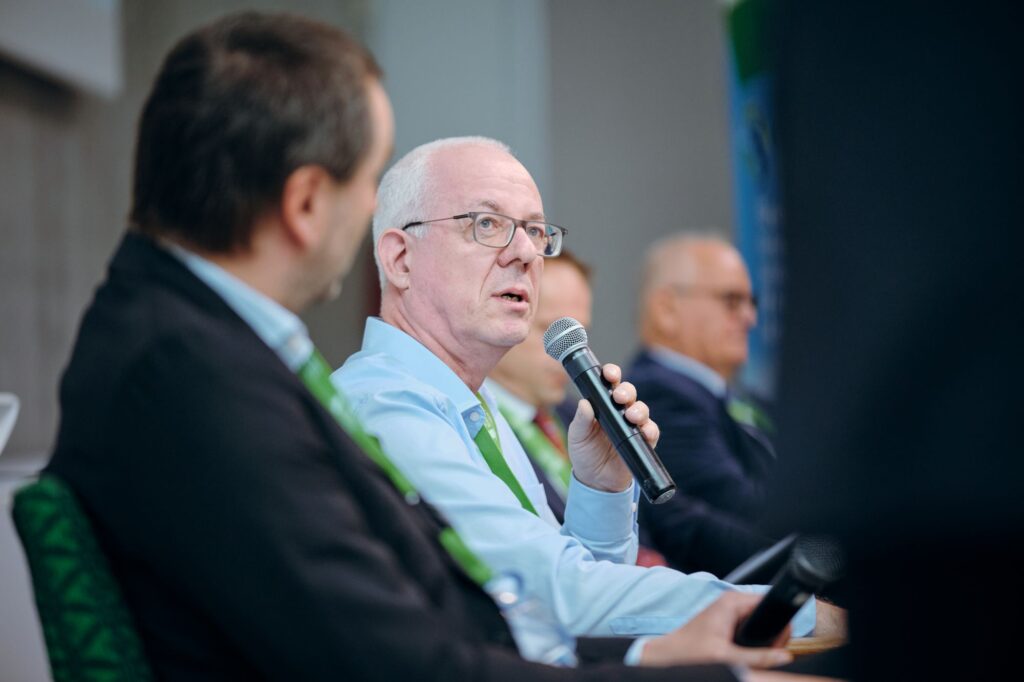
The question was clarified at the Green Shipping Industry Day (GSID) on 24 September 2025 during the panel discussion hosted by the Horizon Europe projects EcoShipyard and CirclesOfLife. In Brussels leading voices from industry, academia, and EU institutions were brought together to explore how sustainability and competitiveness can co-exist in European shipbuilding.
The moderator – Professor Dimitrios V. Lyridis – opened the session by framing the challenge: from sustainable shipbuilding operations to circular approaches at the end-of-life phase of vessels, the maritime sector is undergoing a transformation. EcoShipyard and CirclesOfLife are at the forefront of this shift, developing practical tools such as the Shipyard Environmental Performance Index (SEPI), material passports, and digital dashboards to help shipyards monitor their environmental footprint and improve decision-making.
EcoShipyard & CirclesOfLife Panel:
Greening European Shipyards through Innovation and Collaboration
Both – EcoShipYard and CirclesOfLife – converge on SEPI, demonstrating its value as both a yard-level benchmark and a strategic tool for European policy.
The panel featured six distinguished speakers:
- Benoît Loicq (SEA Europe) emphasized the importance of the Maritime Industrial Strategy in supporting shipyards through the sustainable transition. He called for targeted investment to overcome financial barriers and ensure that sustainability enhances competitiveness.
- Prof. Apostolos Papanikolaou (NTUA, EcoShipYard) highlighted the role of holistic ship design in reducing environmental impact. He stated that maritime sustainability research improves education and noted that while the necessary technologies exist, political alignment is needed at this stage (e.g., IMO net-zero framework).
- Gabriel Mialocq (CINEA) highlighted the significance of EU funding, particularly Horizon projects, in advancing the sector’s decarbonisation trajectory. He encouraged project teams to achieve measurable results and identified the Innovation Fund as an essential resource for scaling tools such as SEPI.
- Stephan Wurst (BALance) discussed the development of SEPI as a digital tool for benchmarking shipyard performance. He noted the challenge of data collection and advocated for leveraging existing datasets to build trust and drive adoption.
- Matthias Krause (CMT) shared insights from real-world case studies, emphasizing the need to bridge the gap between theory and practice. He pointed to surface treatment technologies as examples where automation delivers environmental, economic, and social benefits.
Prof. Marc Bonazountas (NTUA, EcoShipYard) discussed the strategic aspects of SEPI and the potential for ranking shipyards. He also addressed the influence of Horizon projects on scalability. He noted the importance of establishing tangible targets and impact, rather than shifting from one project to another without measurable outcomes.
The panel concluded with five key takeaways for policymakers:
- Boost competitiveness through innovation
- Unlock the potential of circularity
- Align regulation with practice
- Support companies on their journey
- Create green jobs and retain skills
Together, CirclesOfLife and EcoShipYard represent a future where European shipping is more sustainable and competitive, driven by collaboration between research, industry, and policy.
Photo captions:
1. Stefan Wurst (BALance) explaining the development of the Shipyard Environmental Performance Index as a digital tool for benchmarking shipyard performance.
2. Panel from left to right: Professor Dimitrios V Lyridis, Matthias Krause, Stephan Wurst, Gabriel Mialocq, Prof. Apostolos Papanikolaou, Benoît Loicq, Prof. Marc Bonazountas
Photography © Sam Glazier