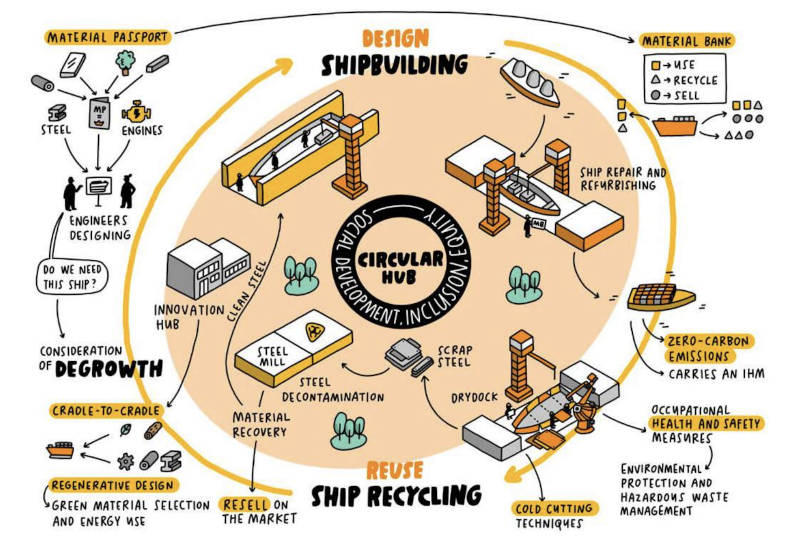
As the European Union advances its green industrial strategy, forward-thinking actors in the maritime and shipyard sectors are stepping up to lead the transition. Industry front-runners — such as the consortium behind CirclesOfLife (COL) — are actively developing roadmaps to make their operations more competitive, sustainable, and aligned with the latest EU regulations on corporate transparency and sustainability.
The COL project takes a full life-cycle approach to ships, which is why the European Ship Recycling Regulation (EU SRR) is one of the key regulatory framework guiding the development of its two main tools: the Shipyard Environmental Performance Indicator (SEPI) and the Ship Lifecycle Passport (SLP). Introduced to safeguard human health and the environment during the dismantling of EU-flagged ships, the EU SRR has the potential to play an even greater role in supporting circular economy goals — particularly in the context of the upcoming Circular Economy Act, expected in Q4 of 2026.
As we explained in our previous article, this Act aims to boost material circularity, enhance the functioning of secondary raw material markets, and create a unified European market for waste — all of which align with the goal of unlocking the value of end-of-life ships as a sustainable source of critical raw materials.
Ships are floating repositories of high-grade steel, non-ferrous metals, and reusable components. With the right dismantling practices, supported by traceability and certification mechanisms, these materials can be reintroduced into the European industrial ecosystem. This contributes not only to the objectives of the EU Critical Raw Materials Act, but also aligns with the broader ambitions outlined in the recent European Steel and Metals Action Plan.
For European shipyards, maritime equipment manufacturers and metal recyclers, this shift presents a concrete opportunity to:
- Secure high-quality, locally sourced steel through safe and responsible dismantling practices.
- Re-imagine shipyards as circular economy hubs, where recovery, reuse, and up-cycling of materials become part of the core business model.
- Collaborate with innovative startups offering creative material up-cycling solutions, adding value across the supply chain.
Enhancing the effectiveness of ship recycling
While the EU SRR has significantly raised environmental and safety standards in ship recycling, there remains untapped potential for it to fully support circular economy goals. Key areas for improvement include:
- Ensuring full lifecycle documentation of ship materials — going beyond the Inventories of Hazardous Materials (IHM) to enable safe and efficient reuse.
- Preventing out-flagging practices, which allow vessels to bypass EU standards by switching flags at end-of-life.
- Establishing a harmonised market for secondary materials, supported by a certification system for steel and components recovered from dismantled ships.
To truly unlock the circular potential, the entire value chain — from dismantling to remanufacturing — must be supported by consistent policy, incentives, and recognition of the inherent value of ships at the end of their operational life.
Building a Circular Maritime Ecosystem
Initiatives like CirclesOfLife are central to this transformation. By addressing every phase of the ship lifecycle — from design and construction to operation and dismantling — COL is helping bridge the gap between regulation, industry practice, and innovation.
The COL consortium stands ready to collaborate with policymakers, share best practices, and contribute to a stronger, more competitive, and sustainable shipbuilding environment in Europe.
European ship recycling is not just about compliance — it’s a strategic opportunity to drive industrial resilience, reduce environmental impact, and secure material independence. By integrating dismantling and material recovery into the EU’s circular economy agenda, the maritime sector can actively contribute to Europe’s clean and competitive industrial future.
We invite all stakeholders to join our community and stay updated with the project development by registering to our CirclesOfLife newsletter and we look forward to see you at our GREEN SHIPPING INDUSTRY DAY for discussing the future of a circular maritime European industry.